

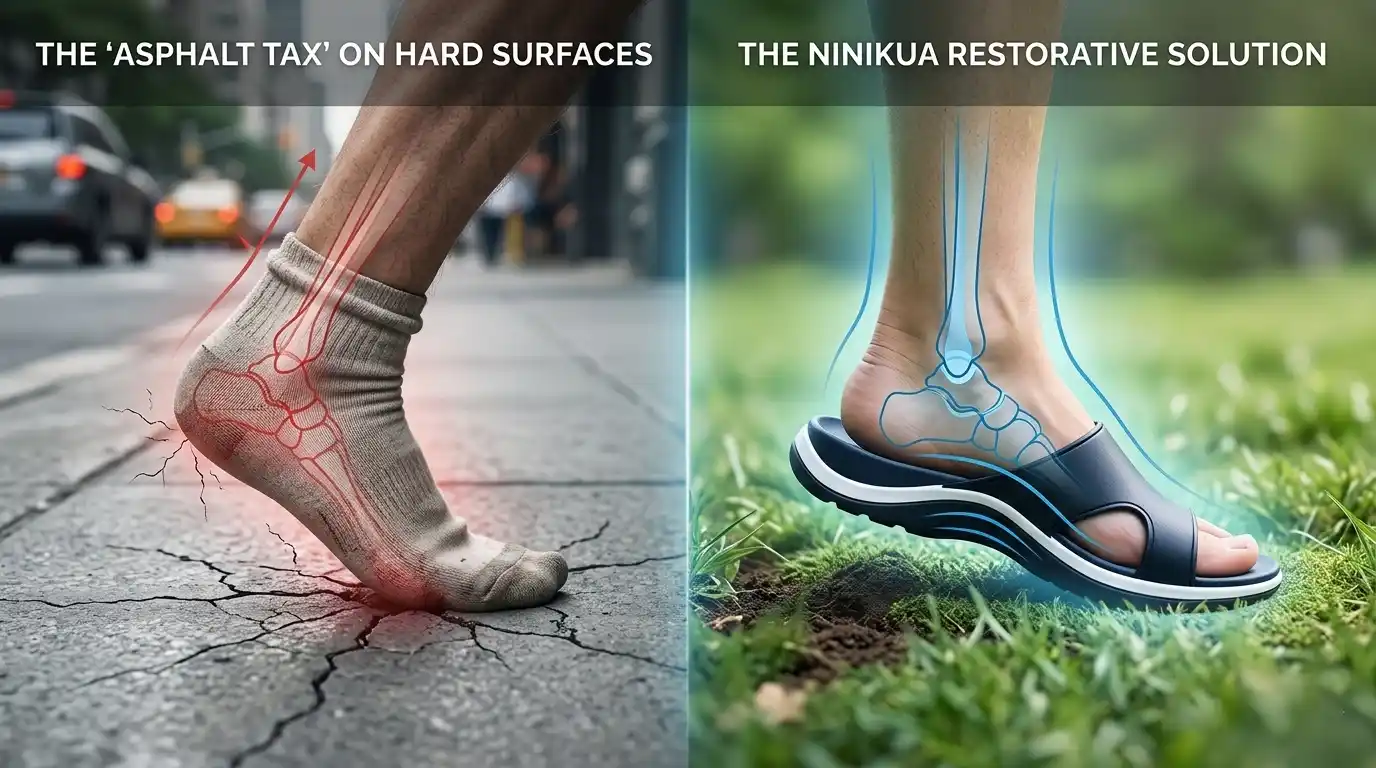
As humans, our evolutionary blueprint was never designed for the concrete jungle. For hundreds of thousands of years, our ancestors traversed natural, yielding terrain—soft soil, damp grass, sandy shores, and forested paths. These dynamic surfaces naturally absorbed impact, compressed under our body weight, and allowed our foot arches to function as the flexible, shock-absorbing leaf springs they were anatomically engineered to be.
Fast forward to the modern era, and our daily reality is drastically different. We walk, run, stand, and commute almost exclusively on unforgiving, non-yielding surfaces: poured concrete, asphalt pavements, hardwood floors, and porcelain office tiles. This stark environmental shift has introduced what podiatrists and biomechanical engineers call the “Asphalt Tax”—a silent, cumulative physical toll levied on our feet, joints, and spine with every single step we take.
The Biomechanics of Impact: What Happens When the Ground Refuses to Yield
To understand why modern flooring compromises our health, we must examine Newton’s third law of motion: for every action, there is an equal and opposite reaction. When your foot strikes a natural surface like grass or soil, the ground itself deforms slightly, absorbing a significant portion of the kinetic energy generated by your stride.
When your heel strikes solid concrete, however, the ground absolutely refuses to yield. Instead, 100% of that kinetic energy is reflected straight back up into your body. This is known as Ground Reaction Force (GRF).
Without proper structural intervention, this repetitive shock wave travels up the kinetic chain of your skeletal system:
- The Plantar Fascia: The thick band of tissue supporting your arch stretches violently beyond its elastic capacity, leading to microscopic tears.
- The Ankle Complex: Forced to over-pronate (roll inward) to artificially create the shock absorption that the ground isn’t providing.
- The Knees and Hips: Misaligned by the pronating foot, the joints rub unevenly, leading to premature cartilage wear and chronic localized inflammation.
- The Lower Back: The spine absorbs the remaining residual shock wave, resulting in dull, persistent lower back aches after a long day of walking or standing.
The Architecture of the Foot: Why Your Arch Needs a Structural Ally
The human foot is a mechanical masterpiece, containing 26 bones, 33 joints, and over a hundred muscles, tendons, and ligaments. The crown jewel of this structure is the medial longitudinal arch. The arch is designed to flatten slightly under load to disperse impact and then snap back into shape to propel you forward.
However, the arch was never designed to endure this cycle on hard, flat ground continuously. On a completely flat surface, the foot is forced to flatten completely to find stability. Over time, this repetitive over-flattening stretches the plantar fascia and weakens the intrinsic muscles of the foot. The result is a progressive collapse of the arch, commonly referred to as acquired flatfoot or overpronation.
This is precisely where specialized, restorative footwear transitions from a luxury item to an absolute medical and lifestyle necessity. An anatomically correct arch support system acts as a structural ally. By filling the geometric void between the contours of your foot and the flat, unyielding ground, it redistributes body weight evenly across the entire plantar surface. It stops the violent over-flattening of the foot, giving tired muscles and overstretched tendons the structural relief they desperately need to heal.
Beyond Basic Cushioning: The Flaw of “Soft” Sneakers
When faced with foot fatigue or chronic ailments like plantar fasciitis, many consumers make the mistake of reaching for the softest, most pillowy sneakers they can find. While thick memory foam or squishy gel soles provide an immediate sense of plush comfort in the shoe store, they often exacerbate structural problems over long-term use.
Cushioning without structural support is a biomechanical trap. Imagine building a house on a foundation of quicksand; the pillowy softness creates lateral instability. As your foot sinks unevenly into ultra-soft foam, your ankle and heel are forced to work twice as hard to maintain balance. This micro-instability strains the stabilizing tendons around your ankle and can actually worsen alignment issues up the kinetic chain.
True restorative footwear utilizes a different engineering blueprint. It prioritizes active recovery through structural stabilization. Instead of just sinking into the shoe, your heel is cradled by a deep heel cup that locks the calcaneus bone into alignment. Concurrently, a firm, contoured arch system prevents the foot from rolling inward. This precise balance of firm structural support and responsive, shock-absorbing materials ensures that your body remains perfectly aligned from the ground up, effectively converting hard concrete pavements into a low-impact, therapeutic walking experience.
Restorative Living: Integrating Foot Wellness into Your Daily Routine
Mitigating the effects of the “Asphalt Tax” doesn’t require you to abandon your urban lifestyle or spend hours in physical therapy. It requires conscious, strategic adjustments to your daily gear rotation.
For office workers, retail employees, healthcare professionals, and anyone whose lifestyle demands prolonged standing or walking, the period immediately following high-impact activity or long working shifts is critical. Your feet need an environment that promotes active recovery. Stepping into a high-performance wellness sandal or slide featuring localized orthopedic contours allows the inflammation in your plantar fascia to subside, re-aligns your posture, and rejuvenates tired leg muscles.
Furthermore, integrating targeted mobility habits can dramatically speed up structural recovery. Simple exercises, such as rolling the arch of your foot over a lacrosse ball for five minutes every evening or executing eccentric calf raises off a step, help maintain tissue elasticity and strengthen the supporting musculature of your ankle complex.
Invest in Your Foundation
Your feet are the literal foundation of your entire physical structure. Every journey you take, every goal you chase, and every daily routine you execute relies entirely on the structural integrity of these two complex anatomical platforms. Neglecting them while forcing them to combat the brutal reality of modern concrete infrastructure is a compromise your joints will eventually pay for.
It is time to stop paying the “Asphalt Tax.” By arming your feet with footwear engineered around real biomechanical principles—combining uncompromising deep heel stability with precision arch contours—you reclaim your natural alignment. Step out with confidence, protect your kinetic chain, and redefine your daily stride with comfort that lasts far beyond the pavement.
Leave a Reply